WhatsApp Marketing for Car Dealerships: How to Actually Use It to Bring Customers Back to Your Workshop
WhatsApp Marketing for Car Dealerships: How to Actually Use It to Bring Customers Back to Your Workshop
Three years ago, sending an email to a dealership customer to remind them about an upcoming service still made sense. Today, that email lands in promotions, gets opened by under 18% of recipients and clicked by about 2%. SMS performs slightly better, but it costs more than the message it contains and customers never reply. On both of the dealership's traditional marketing channels, the signal is now below the noise.
Meanwhile, the customer lives on WhatsApp. They check it dozens of times a day, reply within minutes, and consider it normal to receive messages there from their bank, their child's school, their pediatrician, and their gym. WhatsApp has become the channel for the things that actually matter. It's also, by a wide margin, the most underused channel in European dealer aftersales — and the one that opens the biggest competitive gap for whoever uses it well.
In this article we'll look at why WhatsApp marketing for car dealerships isn't "a nice idea" but a real strategic lever, how to structure it without becoming intrusive, and how connected vehicle telematics turns generic broadcasts into communications that actually drive workshop traffic.
Why Email and SMS Stopped Working in Aftersales
To understand why WhatsApp has become the key channel for dealership marketing, it helps to start with the numbers every service manager already knows.
Average open rate for promotional emails in the automotive sector: between 18% and 22%. Click-through rate: between 1.5% and 3%. On a base of 5,000 customers contacted, that's 75-150 clicks. To turn one of those clicks into a workshop appointment, the typical conversion rate is 5-8%. The end calculation is brutal: a mass campaign generates under ten bookings. Often it doesn't even cover the cost of the software that sent it.
SMS has high open rates (over 90%) but it has become the channel for flight deals and gym subscriptions. Customers perceive it as spam, and there's no way to start a conversation. Even when the message is important, it sits in a queue of nine others that aren't.
WhatsApp behaves in a completely different way. Open rates close to 98%, average response rates of 45-60% on well-crafted commercial messages, typical reply times under ten minutes. It's a bidirectional channel by nature: the customer doesn't just receive, they can reply. And when they reply, you get a conversation, not a funnel step.
For a car dealership this changes everything, because aftersales service is essentially a conversation. "Your car is signalling an unusual oil consumption, can we book a check?" reads cold over email, suspicious over SMS, and completely normal over WhatsApp — followed by a useful reply the same afternoon.
The Three Mistakes That Ruin WhatsApp Marketing for Car Dealerships
Before we look at how to do it well, it's worth being honest about how it's typically done badly — because most dealerships that have tried WhatsApp have done it badly, and now think the channel doesn't work.
First mistake: using it as a megaphone. Blasting the same promotional message to the entire contact list, with the classic "service from £99" offer. The customer immediately senses that it isn't actually you writing to them, and mutes notifications for that number. Unlike email, WhatsApp punishes anyone who treats it as a broadcaster. Two or three bad messages are enough to lose access to that customer forever, because they'll block or report the number.
Second mistake: lack of relevance. Sending the customer generic messages about models they don't own or services they don't need. WhatsApp's rule is simple: every message must be so specific to the recipient that it could not have been sent to anyone else. If you don't have that level of personalisation, don't send.
Third mistake: messages without data. "Reminder: it's time for your service" is a sentence written blind. Maybe the customer just had it done elsewhere, maybe the car has been parked for months, maybe they sold it. Without real vehicle data, every message is a guess, and customers notice. To do WhatsApp marketing for car dealerships properly, you need real-time vehicle data, not just the CRM record.
The Golden Rule: WhatsApp Is a Relationship Channel, Not a Campaign Channel
The right way to think about WhatsApp inside a dealership isn't "a new marketing channel" but "the main channel of the service relationship".
That means most of the messages you send shouldn't sell anything. They should be useful. They should make the customer feel that the dealership is present, knows them, and looks after their car. The sale arrives as a natural consequence of that perception, not as the explicit objective of any single message.
A map of typical messages from a dealership that uses WhatsApp well sits across four categories.
The first is pure information: "your vehicle has covered 14,870 km since the last service, around 1,130 km remain until the next scheduled interval". No commercial offer, no link, just precise information. This category builds credibility.
The second is preventive: "we have noticed unusual behaviour from the injection system, we recommend a check within 30 days". Again, no explicit sale, just advice. If the customer wants to book, they reply, and at that point the dealership opens a dialogue.
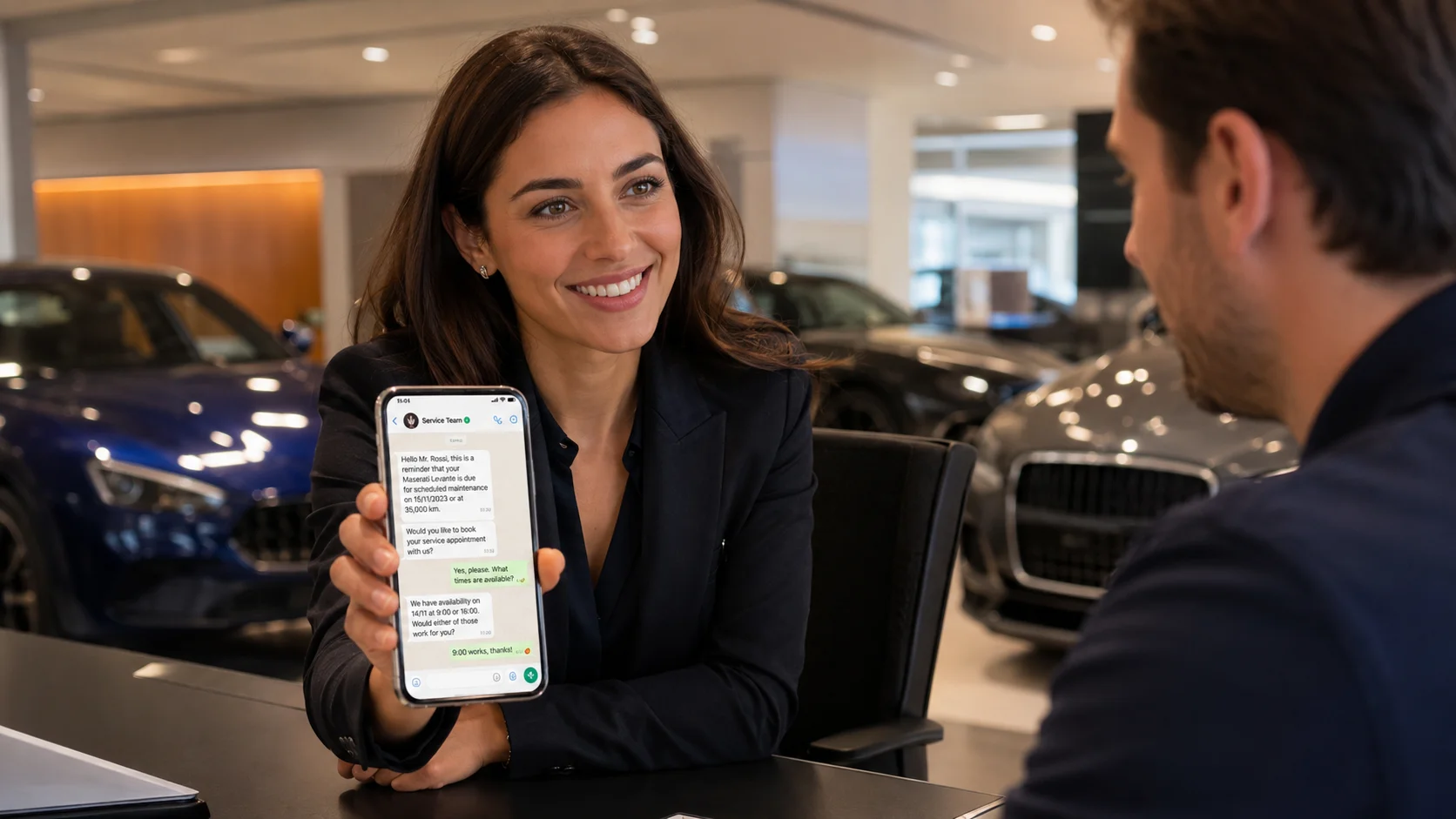
The third is active service: "you have three open slots next week for the check we discussed, which do you prefer?". Once the customer has shown interest, you make it easy for them to act. No call centre, no form, a reply in two taps.
The fourth is contextual: messages tied to specific vehicle events (insurance expiry, MOT, purchase anniversary, telematic alerts). Never seasonal mass messages like "winter tyre offers", which belong to the first generation of WhatsApp automotive marketing and no longer work.
How Telematics Transforms WhatsApp Marketing for Car Dealerships
This whole model assumes something the typical dealership doesn't have: continuous, reliable data on the vehicle after delivery. Without data, every message slips into the generic zone and loses its effect.
This is where connected telematics changes everything. A device like Mobisat's Guardian AI, installed on the car at the point of sale, gives the dealership a continuous flow of information that feeds the WhatsApp channel intelligently.
Continuous reading of vehicle parameters through the OBD-II port lets you know how the car is performing day by day. Oxygen sensors, battery performance, injection behaviour, engine temperature, early error codes. These are the data you normally only see during a service, but they become visible in real time.
AI-driven predictive analysis distinguishes between physiological fluctuations and real signals of upcoming failures. When the model detects a deviation that statistically leads to a fault in the following months, an alert is generated. The dealership receives the signal and can trigger a targeted WhatsApp message to that single customer, carrying information that is impossible to perceive as spam: "we have detected a 12% deviation in your injection values, we recommend a check in the next 20 days".
Continuous monitoring of expiry dates and mileage transforms generic reminders into precise messages. No more "your service is due" pushed cold to the whole database in March, but "you have covered 1,350 km in the last four weeks, around 800 km remain to the next service: would you like to book now?".
The WhatsApp Automation feature included in the platform closes the loop. The system automatically generates three types of communication on the dealership side or directly to the end customer: the monthly vehicle health report, maintenance reminders calibrated on real mileage, and alerts on significant anomalies. Customers perceive these messages as useful because they speak about their specific car, not about a generic fleet.
The Service Portal: Where Everything Comes Together
A dealership that wants to use WhatsApp seriously can't improvise. You need an operational interface that shows the staff who to contact, why, and with what message. The Mobisat platform provides the Service Portal, accessible to dealership teams, and that does exactly this.
The portal aggregates alerts coming from the entire connected fleet, classifies them by urgency, and turns them into work lists. In the morning, the service manager opens the dashboard and sees which customers need contact today: who has a critical alert, who has a service due, who hasn't returned in too long but is accumulating mileage quickly. From there, with a few clicks, a personalised WhatsApp message goes out to the customer, pre-loaded with their vehicle's specific data.
The advantage isn't only operational, it's cultural. You stop running campaigns and start managing conversations. Each conversation produces data on response rate, conversion to appointment, and average revenue per connected customer versus non-connected customer. The commercial leadership finally has numbers to base decisions on, not feelings.
Three Things You Must Never Do With Customers on WhatsApp
Before closing, three absolute rules, because a single mistake here can burn months of work.
Never send promotional messages late at night, on weekends, or on public holidays. The right sending windows for automotive aftersales are Tuesday-Thursday during business hours. Everything else is perceived as intrusive.
Never use messages with heavy images or over-designed templates. WhatsApp is a personal conversation channel: a message that looks like an advert is immediately disqualified. Keep it to essential text, specific data, and at most one piece of technical documentation when needed. Nothing else.
Never sell before delivering value. The practical rule is at least three pure-service messages before proposing anything commercial. If you open a new connected customer with a service offer, you've destroyed the consultant position before you've even built it.
In Short: The Future of Dealership Marketing Is a Conversation
WhatsApp marketing for car dealerships isn't a passing trend or just another tactical channel. It reflects a deeper shift in how dealers create value in aftersales: stop selling repairs, start selling continuous protection of the vehicle.
To get there you need three things that, on their own, aren't enough, and together change the business. A telematics device that brings real, reliable data from the vehicle. A management platform that converts that data into operational alerts. A relationship channel as fast, personal, and trusted as WhatsApp, where every message is justified by data and not by the marketing calendar.
A dealership that installs Mobisat's Guardian AI on the vehicles it sells, manages alerts through the Service Portal, and talks to customers on WhatsApp on the basis of real data, is building something that no independent garage will be able to replicate over the next five years. It's not a communication channel: it's a competitive moat.
It's worth investing here while the window is open. In another twenty-four months it will be the new normal in the sector, and whoever stays on email marketing will be left with the crumbs.
Discover Guardian AI: mobisat.com/greenbox-guardian.html