GPS Car Tracker: Which One to Choose in 2026
GPS Car Tracker: Which One to Choose in 2026
The GPS car tracker market has changed significantly in recent years. Not long ago, the logic was simple: get a device, hide it in the car, and if it ever gets stolen, you can see where it ended up. Today things are far more complex. Professional thieves use signal jammers, insurers ask for certified installations, and the market offers dozens of products ranging from £30 to £500, with enormous differences that aren't always obvious from the spec sheet.
If you're considering a GPS tracker for your car in 2026, this guide will help you understand what actually matters, which features are essential, which are just marketing gloss, and how to choose a product that genuinely protects you rather than just giving you a false sense of security.
Why a GPS Tracker Alone Isn't Enough in 2026
Let's start with a reality check. A traditional GPS tracker does one thing: it tells you where the vehicle is. That's useful, but it's no longer enough, and there are two reasons why.
The first reason is the thieves themselves. Organised groups stealing modern cars use tools that were science fiction a decade ago. Portable jammers that disrupt both GPS and GSM signals, relay-attack devices that clone keyless entry signals from outside your house, silent recovery trucks that can carry a car off in under a minute. A tracker that only transmits position is blind and deaf precisely when it matters most: in the first few minutes after a theft.
The second reason is you. Even if the alarm reaches your phone at 3 a.m., what do you do? Call the police and try to explain over the phone that someone is stealing your car and you have GPS coordinates? In the meantime the thief is moving, the battery is disconnected, the signal is jammed, and by the time anyone acts the car is already in a warehouse.
A modern, serious GPS tracker solves both problems with a combination of anti-tamper technology and human services behind the device. Here's what to look for.
Types of Trackers on the Market
Before talking features, it helps to understand the categories. Car GPS trackers fall into four broad families, each with strengths, limits, and use cases.
OBD Plug-and-Play Trackers
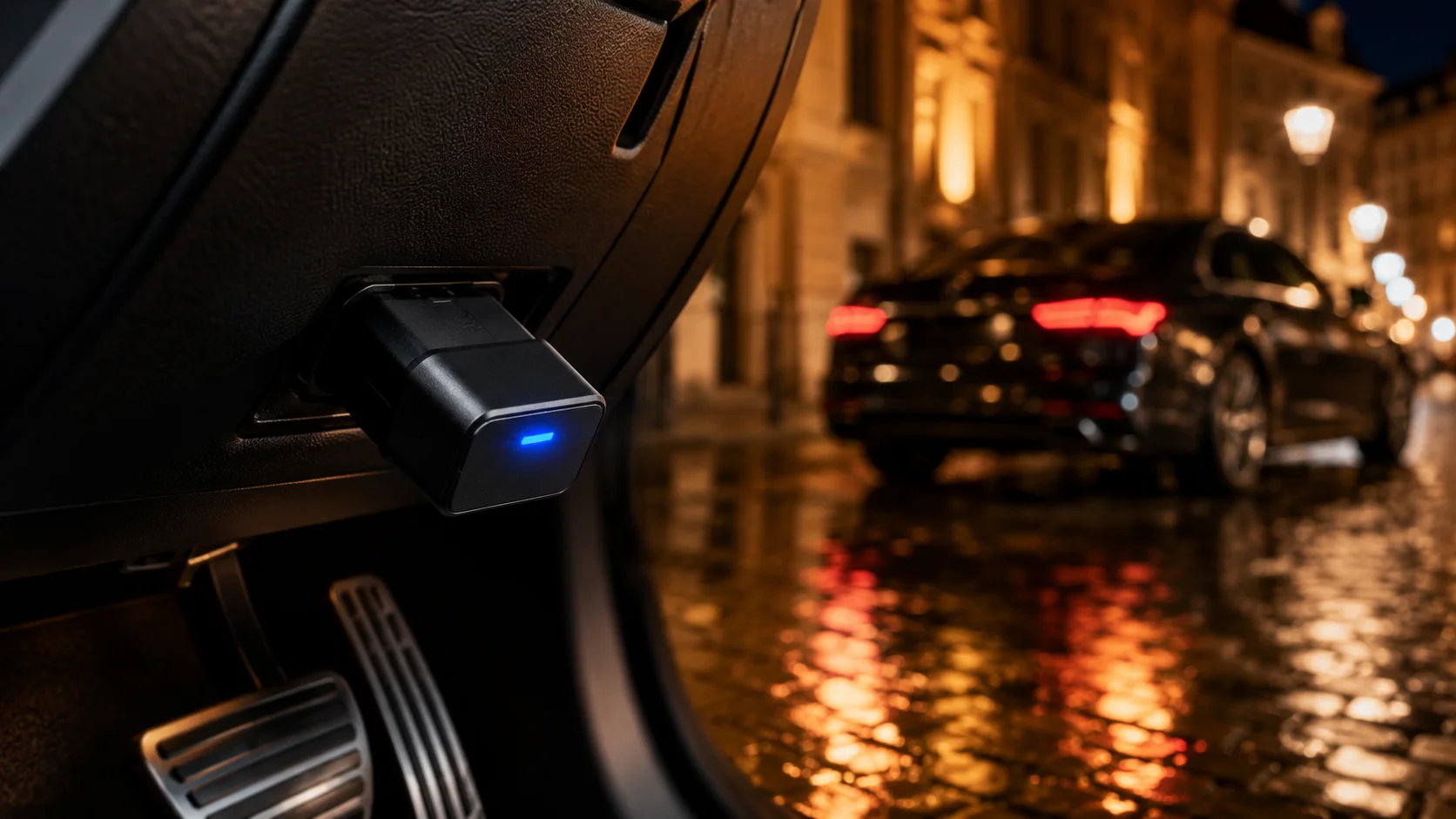
These plug into the car's OBD-II port, the same diagnostic socket a mechanic uses to read engine codes. Installation takes thirty seconds: open the cover, insert the dongle, done. They're powered directly from the vehicle, so there's no battery to recharge, and they can access onboard data, which enables advanced features like diagnostics.
The advantage is simplicity. The limit, for pure anti-theft use, is that a skilled thief knows where to look and can remove them. That's why the most advanced systems pair the OBD dongle with a second, hidden device.
Hard-Wired Hidden Trackers
These are installed in concealed spots inside the vehicle, typically connected to the electrical system via three wires. They require an auto-electrician because correct installation protects the car's wiring and makes the device genuinely hard to find.
This is the most robust anti-theft solution. A thief who doesn't know where to search loses valuable time, during which the operations centre activates the recovery protocol.
Battery-Powered Portable Trackers
These are self-contained devices with a built-in battery that you can place almost anywhere, including a bag or suitcase. The advantage is flexibility, but there are two structural limits: the battery runs out, and placement is always a compromise. They're fine for vehicles you don't want to wire up, such as classic cars or trailers, but they're not the main choice for a daily driver.
Factory-Fitted Trackers
Some newer cars include a manufacturer tracking system, typically tied to a brand-specific service. They're convenient but have two problems: they depend entirely on the manufacturer, which means if they decide to shut the service down or raise the fee, you have no alternative. And the anti-theft features are often limited: no jamming detection, no 24/7 operations centre, no tow detection.
The most robust setup in 2026 is a combined system: an OBD plug-and-play dongle for diagnostics and telemetry, plus a hard-wired hidden device for anti-theft. This is the architecture used by the most advanced solutions, including Mobisat's Guardian AI.
The Essential Features: What a Serious Tracker Must Do
Now to the heart of the matter. When you read a tracker's spec sheet, there are features that must be present and features that are just decorative. These are the seven that really matter.
1. 24/7 Operations Centre
This is the single most important differentiator. A tracker that just sends you an alert is half a tracker. You need people, a real team, who receive the alert in real time, call you for confirmation, launch enhanced tracking, and coordinate with law enforcement on recovery.
Guardian AI, for example, is connected to an operations centre that runs 24 hours a day, 7 days a week. When a theft alarm fires, the centre receives the signal instantly, verifies with you (or proceeds on its own if you don't respond), and activates the recovery protocol using live vehicle coordinates. You're not the one calling the police in a panic at 3 a.m.: there's a team doing it for you with the right information in hand.
If a tracker doesn't have an operations centre behind it, you're buying a locator for tourists, not a car security system. For personal use that may be enough. For protecting a vehicle of real value, it isn't.
2. Jamming Detection
Professional thieves don't force locks with a screwdriver any more. They use GPS and GSM jammers that blind traditional trackers. The tracker thinks it has temporarily lost signal, and by the time the jammer is switched off the car is far away.
Jamming detection is the countermeasure: the system detects when someone is actively disrupting the signal and fires a specific alarm, even before the theft is complete. It's one of the most advanced capabilities a tracker can offer, and in 2026 it's essential for anyone who wants serious protection.
3. Tow Detection
Theft by recovery truck is one of the preferred methods of professional gangs. The car is never started, so many trackers stay asleep. It's simply loaded and taken.
Tow detection uses motion and tilt sensors to catch this scenario: if the car moves without the engine running, the alarm fires. Guardian AI integrates this directly into firmware, alongside 20 other specific alarm types.
4. Multi-Constellation GNSS
Location accuracy depends on how many satellites the tracker can see. Cheap trackers use only the American GPS system. The best ones receive signals from four satellite networks: GPS (United States), GLONASS (Russia), Galileo (Europe), BeiDou (China).
The practical advantage is huge: in cities, where buildings partially block the sky, a multi-constellation tracker keeps location accurate where GPS alone drops out. And if one network is temporarily degraded, the others keep working.
5. Unlimited Geofences
A geofence is a virtual zone on the map: if the vehicle enters or leaves that zone, you get a notification. Cheap trackers often let you create only one or two geofences, with limited rules.
A professional system lets you create unlimited geofences, with rules that depend on day and time. You can define a "home" zone, an "office" zone, a "school" zone, and receive notifications only when and how you want. Guardian AI also includes Quick POI, which lets you create a geofence with a single tap on the map.
6. High-Resolution Tracking
Basic trackers update position every few minutes, with gaps of half a kilometre or more. That sounds minor, but in a recovery situation it makes a huge difference: if the car disappears for four minutes at 100 km/h, that's more than six kilometres of missing track.
Advanced systems use high-density tracking algorithms: position updates every 200 metres, every minute, and at every turn greater than 30 degrees. The result is a continuous path, without gaps, that allows you to reconstruct exactly what happened even at motorway speeds.
7. A User-Friendly Dashboard and App
It may sound like a detail, but it's not. A tracker with great hardware and a clunky app is a tracker you'll use badly, and a tracker used badly doesn't protect you. The dashboard should let you see live position, route history, vehicle data, and configure alarms and geofences without having to call support.
Premium systems include features like Virtual Dashboard Live, which lets you tap on any point in a past journey to see forensic data from that moment: speed, location, engine parameters. Useful for checking a trip, understanding how the car was driven, or providing evidence in a dispute.
Bonus Features That Actually Make a Difference
Beyond the seven core features, new-generation trackers offer services that extend protection well beyond pure anti-theft.
Predictive diagnostics uses artificial intelligence to read the vehicle's OBD codes and flag problems before they become expensive repairs. Guardian AI, for instance, analyses fault codes, explains them in plain English, provides a repair cost estimate, and flags suspicious recurrences. According to Mobisat, this can reduce annual maintenance costs by up to 40 per cent, because you address small issues before they become major ones.
Crash analysis detects collisions automatically and generates a dynamic crash report you can share with your insurer. Instead of being stuck with the other driver's version of events, you have objective data: impact speed, direction, forces involved. This feature completely changes your negotiating position after an incident.
WhatsApp Automation sends monthly reports, service and MOT reminders, and anomaly alerts directly to WhatsApp. No app to open, no notifications to hunt for: alerts arrive where you already read messages.
Monthly AI Report is a complete monthly analysis of the vehicle, generated automatically on the first of each month: engine health, driving style, consumption, scheduled maintenance. It's like having a mechanic send you a report every month without ever visiting the garage.
Deadlines and reminders keep you ahead of insurance, service, MOT, and tax renewals. A seemingly small feature that prevents oversights leading to fines and potentially insurance complications after an accident.
The Installation Certificate and Insurance Discount
One frequently overlooked aspect when choosing a tracker is the potential for a discount on your theft and fire insurance policy. Many insurers recognise discounts, typically 10 to 30 per cent, when a certified anti-theft device is fitted to the car.
To get the discount you need an installation certificate issued by the tracker manufacturer or by the approved installer. Not every manufacturer issues one. Guardian AI, for example, includes the certificate as part of the service.
Before buying, ask your insurance broker which devices your insurer recognises and what discount applies. In some cases the annual savings on the policy cover a meaningful share of the tracker's cost.
What to Avoid
There are also red flags that should rule a product out immediately, regardless of marketing promises.
Be wary of trackers that don't clearly state connectivity costs. The device has to communicate over a cellular network, and that cost is unavoidable. Serious systems include connectivity for a long period (Guardian AI, for instance, includes it for three years with no extra cost). Dubious systems sell you the hardware cheap and then hit you with annual subscriptions that over time cost more than the device itself.
Be wary of anyone promising "worldwide tracking with no subscriptions". It doesn't exist. Cellular data transmission costs money, and if you're not paying, someone else is, which means the service is unstable or about to be shut down.
Be wary of trackers without local-language support. When a theft happens you need to speak to a team that understands you instantly, not a chatbot in English or an offshore call centre.
Avoid devices that install "at home" but require soldering or wiring to the car's ECUs. An installation error can damage the car's electronics. If the tracker is wired, have it installed by a certified auto-electrician.
How to Choose the Right Tracker for You
At the end of the day, the right choice depends on what you actually need. Here are three typical scenarios.
If you want comprehensive protection for a valuable car, go for a combined system with a 24/7 operations centre, jamming detection, tow detection, multi-constellation GNSS, and predictive diagnostics. Systems like Mobisat's Guardian AI are designed exactly for this case and include all these features as standard.
If you have multiple vehicles and want to manage them from a single account, choose a system with native multi-vehicle support and a dashboard that shows all your vehicles at a glance. It's a standard feature of professional systems.
If you just need a basic locator, for a bag or a low-value item, a small battery-powered tracker may be enough. But for a car, investing in a proper system is always the right long-term choice.
Conclusion
In 2026, choosing a GPS tracker is no longer about choosing a device. It's about choosing a platform that combines robust hardware, intelligent software, and a real human service behind it. The question to ask isn't "how much does the tracker cost", but "how much is my car and my peace of mind worth".
A system with a 24/7 operations centre, jamming detection, AI diagnostics and a well-designed app costs more upfront, but it gives value back every day: in real anti-theft protection, maintenance savings, insurance discounts, and peace of mind. A cheap system gives you a false sense of security as long as nothing goes wrong, and leaves you stranded when it actually matters.
Invest in the right level of protection, not the bare minimum. The cost difference pays for itself the first time something critical happens.